There is a quiet revolution underway in global capital markets. It does not make headlines the way interest rate decisions do. It does not produce the dramatic single-day moves that central bank announcements generate. It operates on a different timescale — the timescale of decades rather than quarters — and it is reshaping the structure of private investment in ways that will still be visible thirty years from now.
The revolution is this: private capital is no longer primarily institutional.
For most of the past half-century, the architecture of private markets — venture capital, private equity, private credit, direct investment — was built around institutional capital. Pension funds, university endowments, sovereign wealth funds, insurance companies. These were the limited partners that gave the asset class its scale, its legitimacy, and its operating logic. They provided patient capital in exchange for the returns that public markets could not reliably generate. And they did so within a framework — the fund structure, the management fee, the carried interest, the ten-year fund life — that was designed around their specific needs and constraints.
That framework is now being disrupted from within.
Not by regulation. Not by technology. Not by any of the forces that typically drive structural change in financial markets. It is being disrupted by a new class of capital that has grown large enough, sophisticated enough, and numerous enough to demand different terms — and to get them.
The family office has arrived at institutional scale.
The Numbers
The growth of the family office sector over the past decade is one of the most significant and least-discussed structural developments in global finance.
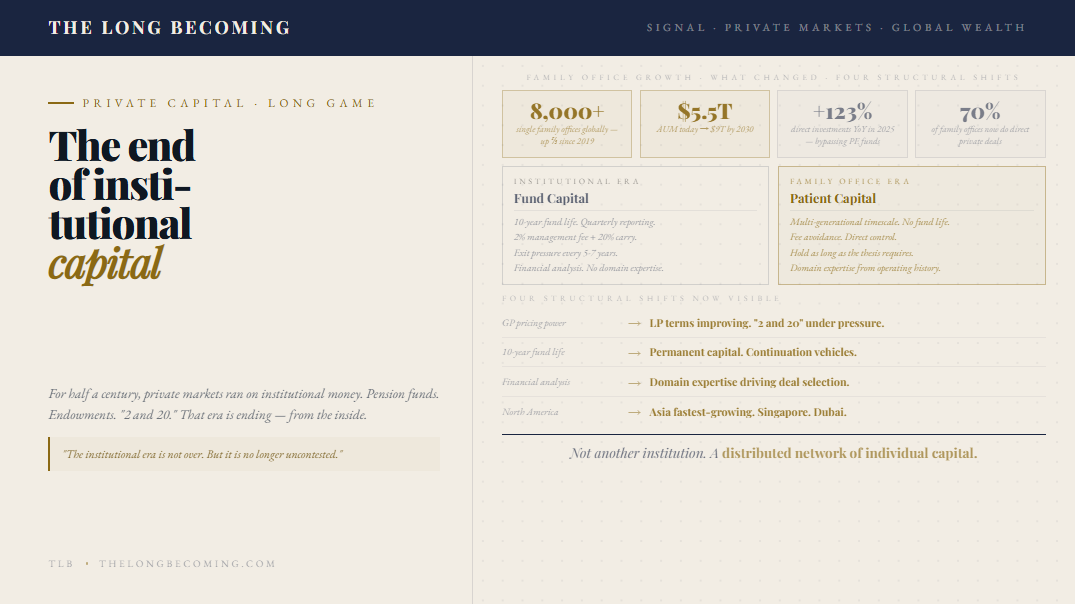
There are now more than 8,000 single-family offices globally — up by a third since 2019, and on track to surpass 10,000 by 2030. They collectively manage approximately $5.5 trillion in assets, a figure expected to exceed $9 trillion by the end of the decade. The average family office participating in J.P. Morgan’s 2026 Global Family Office Report had a net worth of $1.6 billion. The 333 participants in that survey had a combined net worth of $518 billion.
These are not small numbers. They represent a class of capital that, in aggregate, rivals the largest institutional investors in the world — and that is growing faster than any of them.
The underlying driver is the accelerating concentration of global wealth. The world’s ultra-high-net-worth population — individuals with more than $30 million in assets — reached 510,810 people in mid-2025, with collective assets of $59.8 trillion. This cohort is projected to reach 676,970 by 2030. The wealth is being created fastest among first-generation founders in technology, healthcare, and sustainable infrastructure — people who built companies rather than inherited fortunes, who think about capital in operating terms rather than financial ones, and who have specific, domain-grounded views about where value is being created and where it is not.
These people are not content to hand their capital to a fund manager and wait ten years for a report. They are building family offices — sophisticated, direct-investment-capable capital management operations — and they are entering private markets on their own terms.
The End of “2 and 20”
The traditional private equity fund structure was designed for institutional limited partners who needed professional management, diversification across a portfolio of companies, and a standardized reporting framework that their own investment committees could evaluate. In exchange for these services, general partners charged a management fee — typically 2% of committed capital annually — and carried interest — typically 20% of profits above a hurdle rate.
For decades, this was the only viable entry point into private markets for most capital. The fund structure was the infrastructure through which private investment happened.
Family offices are now dismantling this infrastructure from the demand side.
Direct investments by family offices — acquisitions, minority stakes, and funding rounds where a family office invests directly rather than through a fund — rose 123.3% in 2025 compared to the prior year, reaching $12.9 billion across 158 transactions. This was the largest direct investment total recorded since at least 2021. Seventy percent of family offices now participate in direct private deals, either acquiring companies outright or participating in syndicates alongside general partners.
The motivation is straightforward. Every dollar that goes directly into a company rather than through a fund avoids the management fee and the carried interest. On a $100 million investment held for ten years with a 3x return, the difference between direct and fund-mediated investment can exceed $40 million. At scale, across the $5.5 trillion that family offices collectively manage, the aggregate fee avoidance is enormous.
But the shift is not only about fees. It is about control, timescale, and the application of domain knowledge in ways that fund structures do not permit.
Family offices targeting companies in sectors where they have operational experience — healthcare, logistics, fintech, industrials, biotechnology — are not simply chasing yield. They are applying decades of domain expertise to identify value that financial analysts without operating backgrounds cannot see. They are taking board seats. They are embedding family principals in operating companies. They are treating investment as an extension of their operating experience rather than as a financial product to be managed by proxy.
This is a categorically different kind of capital. And its arrival in private markets at scale is changing what founders, operators, and management teams are able to demand from their investors.
The Timescale Advantage
Institutional capital has always been theoretically patient but practically constrained. Pension funds answer to beneficiaries who will retire on a specific schedule. University endowments answer to investment committees that evaluate performance against benchmarks. Even the most long-term-oriented institutional investor operates within a framework of periodic reporting, benchmark comparison, and governance accountability that imposes implicit timescale pressures.
Family offices are structurally different.
A family office exists to serve the wealth management needs of a single family across multiple generations. Its timescale is not determined by fund life cycles or reporting periods. It is determined by the family’s own investment thesis and the generational arc of wealth preservation and growth. A family office that believes a company will be worth ten times its current value in fifteen years can hold that position for fifteen years without the pressure to mark to market, meet a redemption request, or justify the position to an investment committee that benchmarks against public indices.
This is the timescale advantage — and it is one of the most underappreciated sources of value creation available to any investor.
The companies that create the most value are typically the ones that require the most time. The biotechnology company navigating the decade-long arc from discovery to regulatory approval. The infrastructure project that requires years of construction before generating returns. The technology platform that is building network effects that will compound for a generation. These are precisely the opportunities that institutional capital structures are ill-equipped to fund optimally — and precisely the opportunities that family office capital is uniquely positioned to capture.
The arrival of patient, long-term family office capital at scale in private markets is creating a new class of investor-investee relationship — one in which the alignment of interests extends beyond a fund’s contractual life to a genuinely shared horizon.
The Geographic Shift
The family office revolution is not uniformly distributed. Its geography reveals something important about where wealth is being created and how newly created wealth behaves differently from inherited wealth.
North America remains the largest family office market, home to 7,800 of the world’s 8,000-plus single-family offices. But Asia-Pacific is now the fastest-growing region and the second-largest wealth accumulation zone globally. Asian family offices account for approximately 30% of single-family offices worldwide, and 40% of them have been established within the last fifteen years.
This matters for several reasons. First-generation wealth creators — the founders who built the companies that generated the wealth — tend to invest differently from the managers of inherited wealth. They have operating experience. They have industry relationships. They have the specific pattern recognition that comes from having built something from nothing, and they apply that pattern recognition to their investment decisions in ways that are qualitatively different from the financial analysis that drives institutional allocation.
The concentration of first-generation family office capital in Asia — particularly in technology, healthcare, and sustainable infrastructure — is creating a class of investor that combines the capital depth of institutional investment with the domain expertise of operating company founders. This combination is, in many contexts, superior to either dimension alone.
Singapore and Dubai have positioned themselves as the primary hubs for this new capital. Singapore’s fund tax incentive schemes and regulatory infrastructure have made it the preferred domicile for Asian family offices deploying capital globally. Dubai’s positioning as a neutral financial jurisdiction in a geopolitically fractured world has attracted capital from the Middle East, South Asia, and, increasingly, from families seeking to diversify away from regulatory environments they perceive as uncertain.
The geography of family office capital is a proxy for the geography of first-generation wealth creation — and the shift toward Asia reflects where the dominant wealth creation of the past two decades has occurred and where the wealth creation of the next two decades is most likely to occur.
What This Means for Private Markets
The structural implications of the family office revolution for private markets are still being worked out. But several patterns are already visible.
The bargaining power of general partners in private equity is declining. When institutional capital was the only available source of fund capital, general partners could set terms — fee structures, governance rights, reporting requirements, co-investment provisions — largely on their own. Family offices, investing directly or negotiating for co-investment rights alongside smaller fund commitments, are introducing competitive pressure that is slowly but measurably shifting terms in favor of limited partners.
The definition of “patient capital” is expanding. The ten-year fund life that structured private equity for decades is giving way to longer holding periods, continuation vehicles, and permanent capital structures that better match the timescale preferences of family office investors. Companies that would previously have been sold after five to seven years to generate the distributions that institutional limited partners required are increasingly being held longer by family office investors who have no structural reason to exit.
The role of domain expertise in private investment is increasing in importance. Family offices are not allocating capital across diversified portfolios of companies in sectors they do not understand. They are concentrating in sectors where they have operational knowledge and using that knowledge to generate investment returns that exceed what financial analysis alone would identify. This is changing the competitive dynamics of deal sourcing and deal evaluation in sectors where family office capital is most concentrated.
The access barrier to private markets is being restructured. The traditional entry point to private markets — the institutional fund — required commitments of $5 million to $25 million or more, locking capital for a decade in exchange for diversified exposure to a manager’s judgment. Family offices are creating alternative access structures — co-investment syndicates, direct deal networks, shared due diligence resources — that are lowering the effective minimum commitment and increasing the flexibility available to investors of all sizes.
The Pattern
This archive has argued, across multiple essays, that the most significant structural changes in human systems tend to be the ones that move the locus of decision-making from centralized institutions to distributed networks of capable individuals.
The family office revolution is this pattern applied to capital.
For most of the past century, private capital was institutionalized — concentrated in large organizations that made investment decisions on behalf of millions of beneficiaries or clients, operating through standardized structures that prioritized governance and diversification over individual judgment and concentration. This institutionalization was appropriate for an era in which individual capital was too fragmented and individual expertise too uneven to compete with institutional scale.
That era is ending.
The concentration of individual wealth at the levels now visible globally has created a class of private investor who combines the capital depth once available only to institutions with the operating expertise and long-term orientation that institutional structures have always struggled to maintain. The family office is the organizational form through which this new class of investor is entering markets — and it is entering them in ways that are restructuring the architecture of private capital from the inside.
The institutional era of private markets lasted roughly half a century. What replaces it will not be another institution. It will be a distributed network of individual capital pools — each with its own thesis, its own domain expertise, its own timescale — operating through a new infrastructure of direct investment, co-investment syndicates, and shared deal flow that the family office revolution is building in real time.
This is not a prediction about where private markets will be in thirty years. It is an observation about where they are now — and about the direction in which the structural forces currently visible are pointing.
The institutional era is not over. But it is no longer uncontested.
Frequently Asked Questions
What is a family office and why are they growing so rapidly?
A family office is a private wealth management organization established to manage the financial affairs of a single ultra-high-net-worth family. They are growing because global wealth is concentrating at the individual level at unprecedented rates — particularly among first-generation founders in technology, healthcare, and sustainable infrastructure — and because the complexity of managing large, multi-generational, cross-border wealth has made dedicated management infrastructure increasingly necessary and cost-effective relative to the alternatives.
What is the difference between a single-family office and a multi-family office?
A single-family office serves one family exclusively, maintaining complete privacy and customization at the cost of higher per-family infrastructure expense. A multi-family office serves multiple families, pooling operational infrastructure and providing access to institutional-quality investment management at lower per-family cost. Multi-family offices are growing faster than single-family offices as families below the standalone threshold seek co-investment access and compliance scale that individual operations cannot efficiently provide.
Why are family offices moving away from traditional private equity funds?
The primary driver is fee avoidance — bypassing the management fee and carried interest of traditional fund structures, which can consume a significant fraction of investment returns over a fund’s life. But the shift is also about control, timescale alignment, and the application of domain expertise. Family offices investing directly can hold positions for as long as their investment thesis requires, without the pressure to exit that fund life cycles impose. They can also apply operational knowledge from their own business backgrounds in ways that fund structures do not easily permit.
What is the timescale advantage of family office capital?
Family offices are not subject to the fund life cycles, redemption pressures, and benchmark reporting requirements that constrain institutional capital. They can hold investments for as long as their investment thesis requires — five years, fifteen years, or across generations — without the structural pressure to generate distributions on an institutional schedule. This timescale flexibility is particularly valuable in sectors where value creation is inherently long-term, including biotechnology, infrastructure, and technology platforms building network effects.
How is the geographic distribution of family offices changing?
North America remains the largest family office market, but Asia-Pacific is now the fastest-growing region, accounting for approximately 30% of single-family offices globally. The growth is driven by first-generation wealth creators in technology, healthcare, and sustainable infrastructure who are establishing family offices to manage wealth generated through company building rather than inheritance. Singapore and Dubai have emerged as preferred hubs for Asian and Middle Eastern family office capital, offering favorable regulatory environments and geopolitical neutrality.
What does the family office revolution mean for companies seeking capital?
For companies in sectors where family office capital is concentrated — healthcare, biotechnology, technology, infrastructure — the family office revolution is creating a new class of investor that offers patient, domain-knowledgeable capital without the timescale pressures of traditional fund structures. Family offices can be more flexible on valuation, more patient on returns timelines, and more operationally engaged than institutional fund investors. For the right company at the right stage, family office capital can be structurally superior to institutional fund capital — both as a financial resource and as a source of operational expertise and long-term partnership.
SIGNAL tracks the recurring patterns of human experience across history, philosophy, and science — for people living long enough to encounter them more than once.
For those who intend to last.